


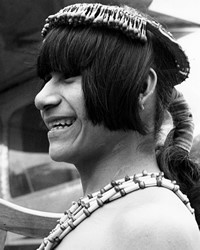

The Wampis are an indigenous people of the Peruvian Amazon, living primarily along the Santiago and Morona rivers in the remote jungle lowlands of northeastern Peru—more than 1,500 kilometers and the Andes mountains separating them from Lima. They speak Wampis, a language of the Jivaroan linguistic family, related to the tongues of neighboring groups such as the Awajún and Achuar.
For centuries, the Wampis maintained their independence through fierce resistance to outside powers. The Inca Empire attempted to expand into their territory in the fifteenth century but failed to establish lasting control. When Spanish conquistadors arrived in the 1540s, the Wampis again pushed back. Though a brief colonial presence was established, the Wampis dismantled Spanish settlements by the end of the sixteenth century and reclaimed their land. Jesuit and Franciscan missionaries made repeated efforts to establish a presence among them in the eighteenth and nineteenth centuries but met similar resistance.
In 2015, the Wampis took a landmark step by constituting the Autonomous Territorial Government of the Wampis Nation (GTANW), the first indigenous autonomous government in Peru. Representing communities unified to protect over 1.3 million hectares of ancestral rainforest, this initiative reflects the deep connection the Wampis hold to their land and their enduring capacity for self-determination.
Life for the Wampis revolves around the rainforest and the rivers that run through it. Their primary livelihood is horticulture practiced through slash-and-burn cultivation—a method interwoven with beliefs about the natural and spiritual worlds. Gardens yield staple crops like manioc, plantains, and sweet potatoes. Hunting, fishing, and gathering supplement what the garden provides, and food production carries a significance that is both practical and ceremonial.
Family life is organized around a high degree of autonomy at the household level, with communal assemblies providing broader governance. Families and communities elect leaders and manage shared resources, including rules for wildlife conservation and use of the land. Men have historically been warriors and hunters; women tend the gardens and the home. This structure is evolving as younger generations take on new roles shaped by education and engagement with the wider Peruvian society.
Celebrations and communal gatherings mark important transitions in life and the agricultural cycle. Music, storytelling, and ceremony bind the community together and pass on knowledge from one generation to the next. Youth leadership has become increasingly valued, with the community investing in training programs to prepare young men and women—including young women like Katse Lili Noningo Antich—to carry the responsibilities of their people into the future.
The primary religious framework among the Wampis is ethnic religion. Their worldview understands the physical and spiritual worlds as deeply interconnected. Spirits inhabit natural places, animals, and elements of the landscape. The earth itself, called Nunkui, is seen as a living mother whose domain includes the subsoil, while Nayaim refers to the sky world above. Ritual specialists navigate the spirit world on behalf of the community, seeking protection, healing, and guidance.
A small but real Christian community exists among the Wampis, with evangelical believers present in the population. The New Testament has been translated into Wampis, and audio resources, the JESUS Film, and Bible apps are available in the language. This means some Wampis men and women have had the opportunity to hear and receive the good news that Jesus Christ—the one who holds authority over every spiritual power—offers freedom, forgiveness, and a relationship with the living God.
Access to quality healthcare and education remains limited in the remote river communities where the Wampis live. Threats from illegal mining, logging, and oil extraction continue to endanger both the natural environment and community stability. Young people face pressure as outside influences increase, sometimes pulling them away from their communities without adequate preparation for life beyond the forest. The Wampis also need the full Bible translated into Wampis so that a complete Scripture is available in their heart language.
Pray for the small community of Wampis believers—that they would grow in faith, understand the full authority of Jesus over all spiritual powers, and become bold witnesses to their own people.
Pray that Wampis Christians would sense a calling to carry the gospel to peoples and communities that have not yet heard, becoming cross-cultural workers themselves.
Pray for Bible translators working to complete the full Wampis Scripture, and for the Spirit to use the New Testament and audio resources already available to transform hearts.
Pray for the protection of Wampis land and communities from illegal extraction industries, and for leaders who will govern with wisdom and care for both people and creation.
Scripture Prayers for the Wampis in Peru.
https://en.wikipedia.org/wiki/Huambisa
https://iwgia.org/en/peru/3265-wampis-nation-peru
https://report.territoriesoflife.org/territories/ina-wampisti-nunke-peru/
https://rainforestjournalismfund.org/projects/impact-autonomy-wampis-people-peru-preservation-amazon-forest-and-combating-climate-change
https://www.xapiriground.org/indigenous-heritage/awajun-wampis
https://international-partnerships.ec.europa.eu/news-and-events/stories/promoting-youth-leadership-indigenous-community-peru_en
| Profile Source: Joshua Project |


